The Method//9 min read
What Is TriMethod Training? Cardio, Strength, and Functional in 60 Minutes
The method behind every Society 3 class: three zones in a set order, five minute blocks on a fixed clock, one coach for 24 people, and why it is built that way.
TriMethod is the one class format at Society 3 in Woodland Hills: 60 minutes, three zones, three rounds, one coach on the floor the whole time. Every round is 5 minutes of cardio, 5 minutes of strength, and 5 minutes of functional work, with timed transitions between them. Do that three times and the hour is over. That is the whole method, and this post is about why it is built that way.
If you have been searching for circuit training classes near you and wondering how this differs from a bootcamp, a HIIT studio, or the circuit you used to run at a big gym, the short answer is the order, the clock, and the coach. The longer answer follows. If you want the logistics first, our guide to what to expect at a Society 3 class covers parking, pricing, and what to bring.
What does TriMethod mean?
Tri is the three zones: Cardio, Strength, and Functional. Method is the rule that you train all three every single class, in the same order, for the same amount of time. Nothing about the hour is left to how you feel when you walk in.
Most training programs make you choose. Cardio days and lifting days. A stretch class on the weekend if you remember. TriMethod puts all three in one room and one hour because the three things adults are told to do for their health are rarely done together. The World Health Organization's physical activity guidelines ask adults for 150 to 300 minutes of moderate aerobic activity a week, plus muscle strengthening on two or more days, plus balance and mobility work as we age. One TriMethod class touches every line of that list.
The format also has a name so you always know what you booked. There is no mystery class, no surprise format, and no week where the schedule quietly turns into something else. The programming inside the format changes on a six-week cycle. The shape of the hour never does.
How a TriMethod class is built, minute by minute
Each round runs 5 minutes on your cardio machine, a 1:30 transition, 5 minutes at your Strength station, another 1:30 transition, 5 minutes at your Functional station, then a 2:00 break. That is a 20 minute round, and there are three of them. Tap through one below to see how the clock moves.
One class, sixty minutes
0:00 elapsed of 60:00
Round 1 of 3
Cardio
Round 1 of 3, Cardio, 5:00.
Five minutes on the machine you picked, at your own pace.
Add it up and a class is 45 minutes of actual work and 15 minutes of moving, breathing, and resetting. That ratio is deliberate. The transitions are long enough to wipe your station, walk to the next zone, and get set, so nobody is sprinting between machines. The 2:00 break at the end of each round is where your coach checks in, adjusts weights, and resets the room for the next round.
Because the clock is identical every session, you can predict exactly how hard the next five minutes will be and exactly when they end. That predictability is not a small thing. It is the difference between pacing yourself and surviving.
The three zones, and why they come in this order
The order is not random. Cardio, then strength, then functional, is the sequence that lets each block set up the next one.
Three zones, one hour
Cardio
5 min per round
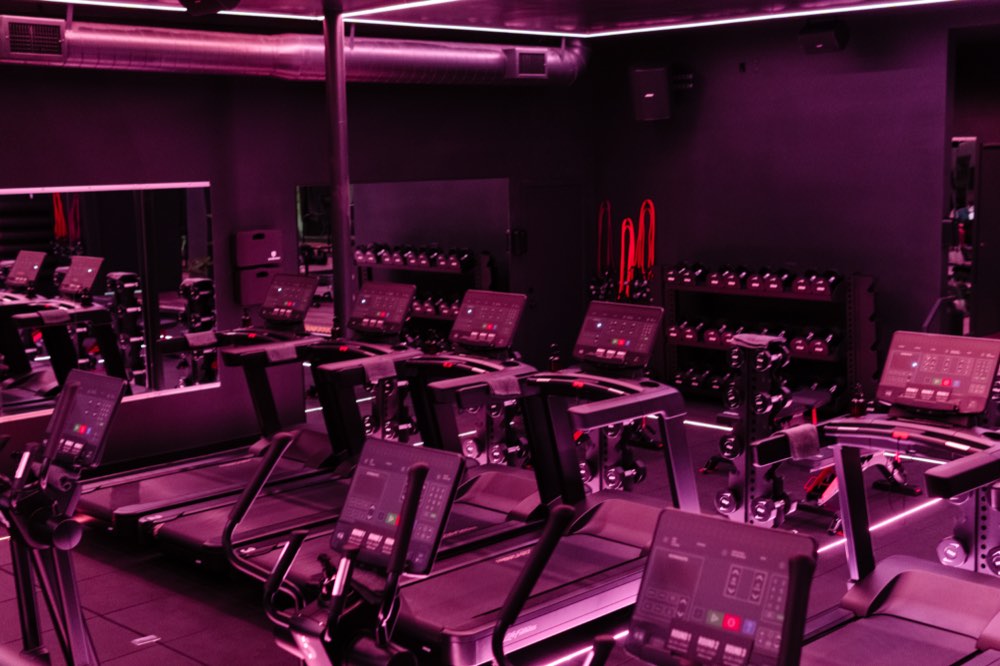
Cardio zone, five minutes per round. You pick your machine when you arrive: bike, elliptical, treadmill, or stair climber. It is yours for the whole class, and it only ever goes your pace.
Cardio first: warm, not wrecked
The Cardio Zone is treadmills, stationary bikes, ellipticals, and stair climbers under red light. You choose your machine type when you book, and it runs at your pace. Five minutes is long enough to raise your heart rate and warm the tissue you are about to load, and short enough that you arrive at the Strength Zone ready to lift rather than gassed. Your coach calls the effort, so the same five minutes can be a steady climb for one person and intervals for the person on the next machine.
Strength second: load while you are fresh
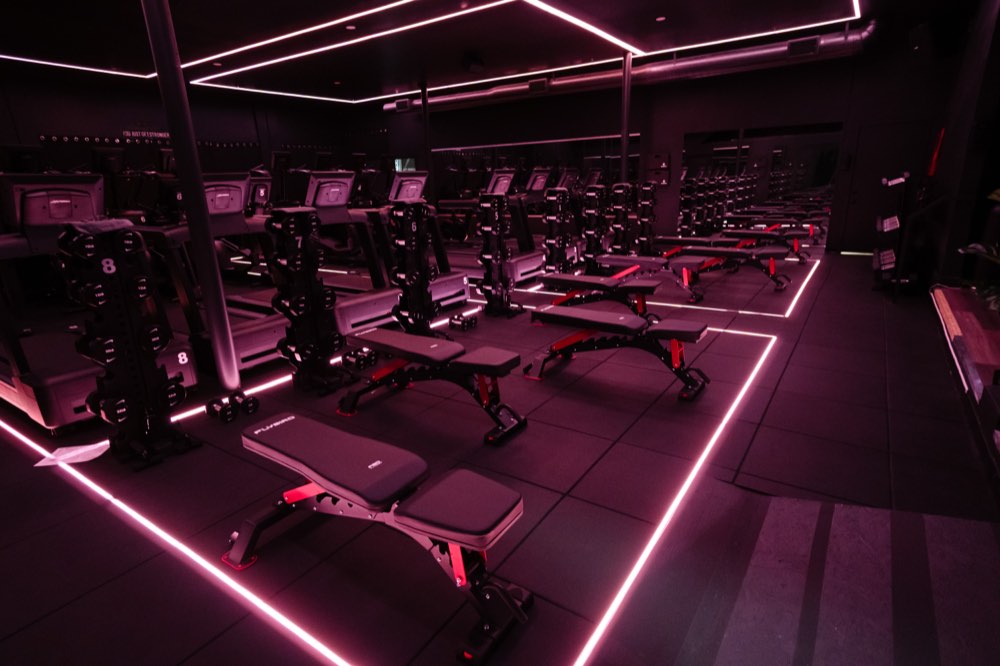
The Strength Zone is numbered stations with adjustable benches, dumbbell towers, and resistance bands, staged before you walk in. Strength comes second because it is the block that benefits most from being fresh and warm at the same time. The Mayo Clinic's guidance on strength training is that two or three sessions a week of major muscle group work is enough to build strength, protect bone, and make everyday tasks easier, and that form matters more than load. Five focused minutes at a station your coach is watching is a strength session with the guesswork removed.
Functional third: the part most people skip
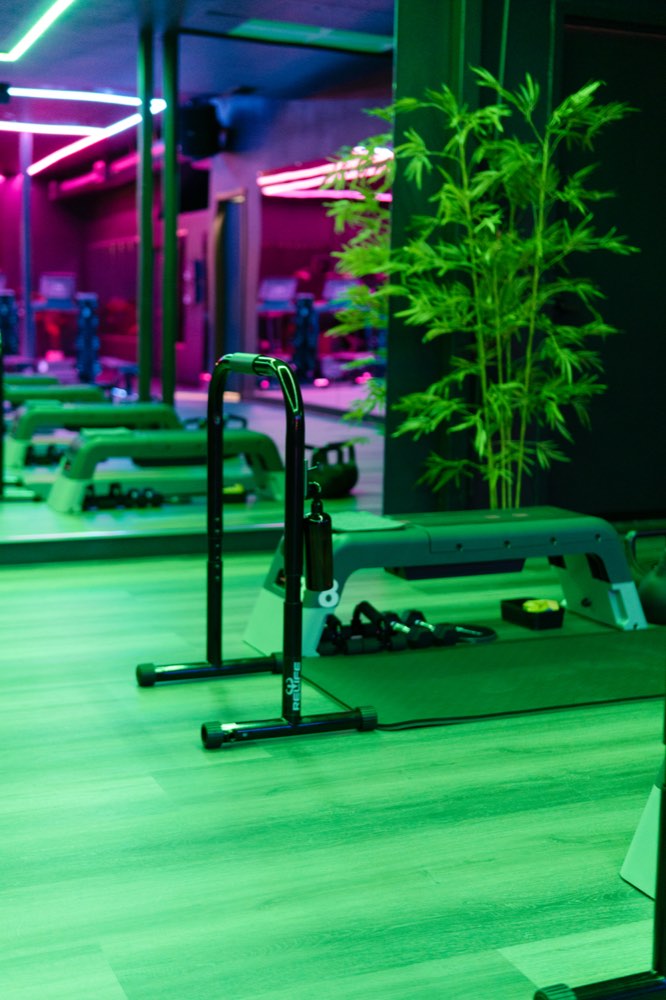
The Functional Zone is mats, kettlebells, foot slides, and steppers. This is mobility, stability, and joint-friendly work: hinges, carries, crawls, single-leg balance, and core positions that show up in real life far more than a bench press does. It comes last because it is the block that keeps the other two sustainable, and because a body that has just lifted is exactly the body that needs to move through range before it stiffens. Harvard Health lists four types of exercise everyone needs: aerobic, strength, balance, and flexibility. The last two are the ones that quietly disappear from most people's week, and the Functional Zone is where they live here. Most people leave it off their own program. Here it is a third of the hour.
What changes from class to class
The format holds. The work inside it rotates on a fixed weekly pattern:
- Monday and Thursday are Push Day. Pressing patterns in the Strength Zone, quad and glute dominant work in Functional.
- Tuesday and Friday are Pull Day. Rows, hinges, and pulling patterns, with posterior chain and grip work in Functional.
- Wednesday and Saturday are Animal Flow days. Ground-based bodyweight movement that trains mobility, coordination, and control, with the cardio and strength blocks lighter to match.
Programming runs in six-week cycles written by our coaches, Arvin and Kelcey. In a cycle the movements stay consistent so you can actually get better at them, and the loads, tempos, and rep schemes progress week over week. Week five is harder than week one on purpose, and then the cycle resets with new movements so nothing goes stale. Sunday is reserved for the Recovery Suite, which is a different session entirely with no zones and no clock.
What the coach actually does for 60 minutes
A TriMethod coach does not stand at the front demonstrating. The workout is programmed before you arrive, so during class their only job is the 24 people on the floor. They call the round, watch form at the Strength stations, adjust weights, swap a movement for anyone with a cranky shoulder or knee, and use the 2:00 breaks to check in with people by name.
That is only possible because the class is capped at 24 and split into three groups of 8. Each group is in a different zone at any moment, which means the coach is never trying to watch 24 people doing 24 different things. They are watching 8 people lift, while 8 people ride at their own pace and 8 people work on a mat. If you have been in a room of 40 people with one instructor shouting over the music, you know why that matters.
Is TriMethod the same as circuit training?
It is a form of circuit training, with three rules most circuits do not have.
The stations are fixed and yours. In a typical circuit you rotate through a row of exercises and hope the next one is free. At Society 3 your station number is assigned when you book. It is your machine in Cardio, your bench in Strength, and your mat in Functional for the entire hour, so there is no waiting and no scrambling.
The blocks are long. Many circuit and HIIT classes run 30 to 45 second stations. Five minutes is long enough to do real work: enough sets to feel a lift, enough time on a machine to settle into a pace. Short stations are exciting. Five minute blocks are where progress lives.
All three zones, every time. Most circuits are one thing dressed up as variety: a strength circuit, or a cardio circuit with a few squats in it. TriMethod is three genuinely different kinds of training, in a set order, with a third of the hour given to the mobility work that most programs treat as optional. If you are weighing us against other formats, we wrote an honest comparison of Society 3 and the other studios in the area.
Who TriMethod is for
Anyone who wants to be stronger, fitter, and moving better without running three separate programs. Beginners, because the coach scales every block and your machine runs at your pace. Experienced lifters, because five minutes at a loaded station is real work and the functional block will find the gaps. People with a bad knee or shoulder, because a coach who watches 8 people at a time can actually adjust for you. And busy people most of all, because the entire week's checklist fits in an hour you can put on a calendar.
Who it is not for: anyone who wants to be left alone with a machine and their headphones. This is a coached class in a room of 24, and it works because of that.
Try a TriMethod class
The fastest way to understand the method is to take one class. Society 3 is at 21144 Ventura Blvd in Woodland Hills, with TriMethod running Monday through Saturday from 6:00 AM, at lunch, and into the evening. Pick a time on the live class schedule, choose your cardio machine, and arrive 15 minutes early. Our first class guide covers what to bring and how the waiver works.
A drop-in is $35 and class packs bring that down to $31 a class. If it becomes a habit, memberships are month to month, and founding rates from $169 are still open but closing soon. Questions first? Call (747) 204-4499, text (818) 936-6229, or email meow@society3studios.com, and a real person answers.
Asked and answered.
What is TriMethod training?
TriMethod is the class format at Society 3 in Woodland Hills. Every class is 60 minutes and cycles through three zones in a set order: Cardio, Strength, and Functional. Each round is 5 minutes in each zone with 1:30 transitions and a 2:00 break, and there are three rounds. One coach runs the whole hour for a class capped at 24 people.
Is TriMethod the same as circuit training or HIIT?
It is a form of circuit training with three differences. Your station is assigned when you book and stays yours all class, so there is no waiting. Blocks are 5 minutes rather than 30 to 45 seconds, which is long enough for real strength work and steady cardio. And every class covers all three zones, including a full third of the hour on functional and mobility work.
Why does the class go cardio, then strength, then functional?
Cardio first warms you up without wearing you out, so you arrive at the Strength Zone ready to lift. Strength second lets you load while you are fresh and warm. Functional last moves you through range after lifting, which keeps the other two zones sustainable and covers the mobility work most people skip.
What changes between TriMethod classes?
The format is always the same, but the work rotates on a weekly pattern: Monday and Thursday are Push Day, Tuesday and Friday are Pull Day, and Wednesday and Saturday are Animal Flow days. Programming runs in six-week cycles built by the coaches, so movements stay consistent inside a cycle and progress week over week.
Do I need experience to take a TriMethod class?
No. Your cardio machine runs at your pace, every strength movement has a lighter version, and the coach watches 8 people at a time in each zone, so they can adjust for you. Tell your coach about any injury before class. Participants must be 16 or older.
How much does a TriMethod class cost?
A drop-in is $35, a 5 class pack is $160, and a 10 class pack is $310, all good for 90 days. Memberships are month to month, with founding rates from $169 for The Core still open but closing soon and unlimited TriMethod from $229 on The Committed.
The hard part
is booking it.
Everything after that is coached. Pick a time that fits and we will handle the rest.
Book Your First Class